
The Reality: Humans Are the Weakest Link
Cyberattacks today don’t just target systems. They target people. The World Economic Forum estimates that 95% of cyberattacks originate from human error.
Phishing emails, fake websites, and social engineering remain the most common entry points. According to KnowBe4’s 2025 Phishing Report, phishing attempts that bypass secure email gateways have increased by 47%, allowing more malicious emails to reach employee inboxes. Once they do, these attacks rely on trust, urgency, and simple mistakes to succeed.
While companies invest heavily in firewalls and email security solutions to secure their organization’s mailboxes, technology alone cannot prevent an employee from accidentally opening the door. As cybersecurity experts often note: security does not fail because tools are missing, but because human risk is left unmanaged.
Despite the growing threat landscape, 40% of employees have never received security awareness training, while only 27% have high confidence in their organization’s security measures. This is why Human Risk Management is no longer optional. It is a business necessity. One wrong click is all it takes.
Understanding Human Risk in the Age of AI
The challenge is becoming even greater as Artificial Intelligence (AI) transforms the way cybercriminals operate. According to the Connecticut Business & Industry Association (CBIA), AI can analyze publicly available data from social media, websites, and public records to create highly personalized phishing messages in just seconds. Phishing emails are becoming increasingly difficult to distinguish from legitimate communications.
Beyond emails, AI is also being used to generate fake websites, realistic chat messages, and even voice and video deepfakes designed to deceive victims into revealing sensitive information or authorizing fraudulent transactions. As a result, organizations can expect attacks to become more frequent, sophisticated, and convincing.
This is why Human Risk Management plays a critical role. Human Risk Management is a strategic, data-driven approach to identifying, measuring, and reducing cybersecurity risks caused by human behaviour. It recognizes that different employees face different threats. High-risk groups such as senior executives, IT administrators, and HR personnel often face attacks tailored to their specific roles and access levels.
Protecting an organization is not solely the responsibility of the IT team. Every employee plays a role in strengthening the human firewall.
Moving Beyond Compliance: Human Risk Management
The Traditional Training Model: Information Delivery
Traditional security awareness training is primarily focused on information delivery. It is often treated as a one-time exercise designed to meet compliance requirements rather than build lasting cybersecurity awareness.
Here’s a typical flow of a traditional security awareness training:
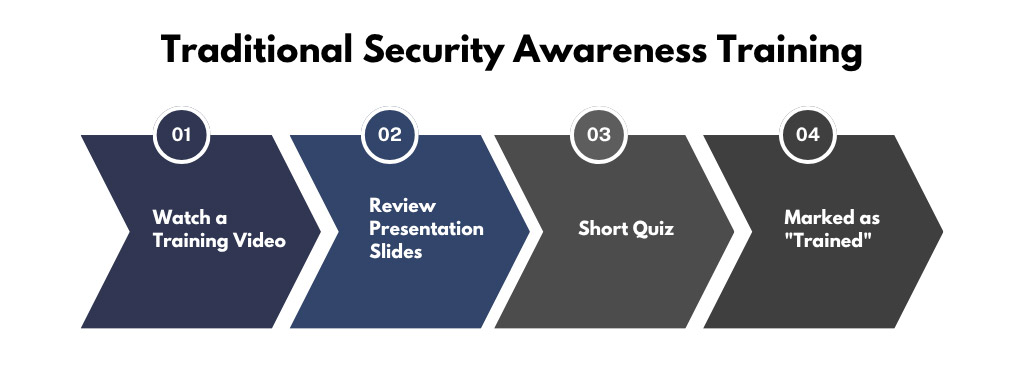
The primary goal is knowledge transfer, compliance, and audit documentation.
The challenge is that awareness alone does not always translate into action. Even when employees know how phishing works, they may still click when an email feels urgent, appears to come from leadership, or catches them during a busy moment. In high-pressure situations, knowledge can easily be overridden by instinct. This highlights the need for more continuous, behaviour-focused security awareness training that strengthens the human firewall over time.
Human Risk Management: Behavioural Change
Human Risk Management takes a fundamentally different approach from traditional security awareness training. It focuses on continuously identifying, measuring, and reducing human risk across the organization, supported by AI and behavioural analytics.
Rather than a one-off session, Human Risk Management is continuous:
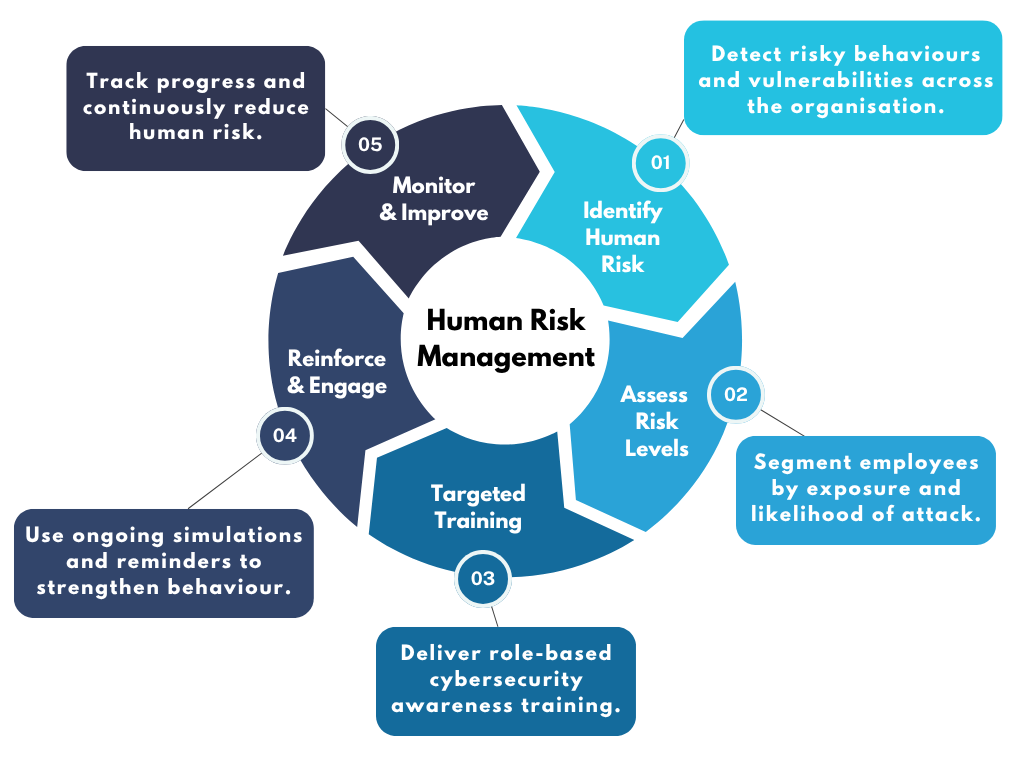
The goal is to build automatic responses over time. Employees learn to pause before clicking, verify before approving sensitive requests, and report suspicious activity instinctively. With repetition, these actions become habits rather than deliberate decisions.
Unlike traditional cybersecurity awareness models, Human Risk Management uses ongoing measurement, AI-driven insights, and continuous reinforcement to actively reduce human risk and strengthen the human firewall.
Ultimately, the focus shifts from simply delivering information to shaping decision-making under pressure. The objective is not just awareness but building employees who consistently act as a strong human firewall.
Traditional Security Awareness Training vs Human Risk Management
At a glance, Human Risk Management builds on traditional security awareness training by taking a more proactive and effective approach to managing human cyber risk:
| Traditional Security Awareness Training | Human Risk Management |
| Focuses on information delivery | Focuses on behavioural change |
| One-time training session | Continuous reinforcement |
| Compliance-driven | Risk reduction-driven |
| Tick-the-box exercise | Long-term habit building |
| Passive learning | Active response practice |
| Knowledge transfer (“know the risks”) | Behavioural conditioning (“act safely”) |
| Generic training for all users | Personalized learning based on user risk levels |
| Limited visibility into human risk | AI-driven risk assessment and user profiling |
| Limited real-world effectiveness | Designed for real attack scenarios |
| Success measured by completion rates | Success measured by behaviour metrics |
Building a Human Firewall Across Your Organization
Effective cybersecurity awareness helps employees recognize phishing attempts more confidently, leading to reduced phishing click rates and increased reporting of suspicious emails. As employees become more aware of potential threats, they make secure decisions more consistently in their daily work, helping to strengthen overall security culture across the organization.
This also extends to practicing safer habits such as using strong passwords, following password best practices, and consistently adopting multi-factor authentication (MFA). Together, these behaviours contribute to building a stronger human firewall.
Partnering with Adventus for Human Risk Management
Building a strong human firewall requires continuous effort, not a one-time rollout. In Human Risk Management, cybersecurity awareness is not delivered as isolated training sessions, but as an ongoing, structured approach that continuously shapes employee behaviour and reduces human risk over time.
At Adventus, we take a consultative approach to Human Risk Management by managing the full lifecycle of the programme from strategy to optimization. This includes phishing simulations, training deployment, reporting, and performance tracking, ensuring that organizations do not just deliver awareness, but drive measurable behavioural change.
Our approach is built on four key pillars:
1. Assessment & Strategy
- Identify organizational risk profile through user security assessments
- Understand employee behaviour, exposure, and risk levels
- Align training with modern-day cybersecurity threats and evolving attack trends
2. Customized Campaign Design
- Tailored phishing simulations based on real-world attack scenarios
- Tailored training modules designed for relevance and engagement
- Role-based learning to reflect different user responsibilities and risk levels
3. Deployment & Management
- Ongoing campaign management to ensure consistency and engagement
- Continuous performance tracking to monitor behavioural change
- Reporting analytics to provide visibility on risk and progress
4. Continuous Optimization
- Data-driven insights to guide improvements
- Behavioural improvements tracked over time
- Campaign refinement to adapt to emerging threats and user behaviour trends
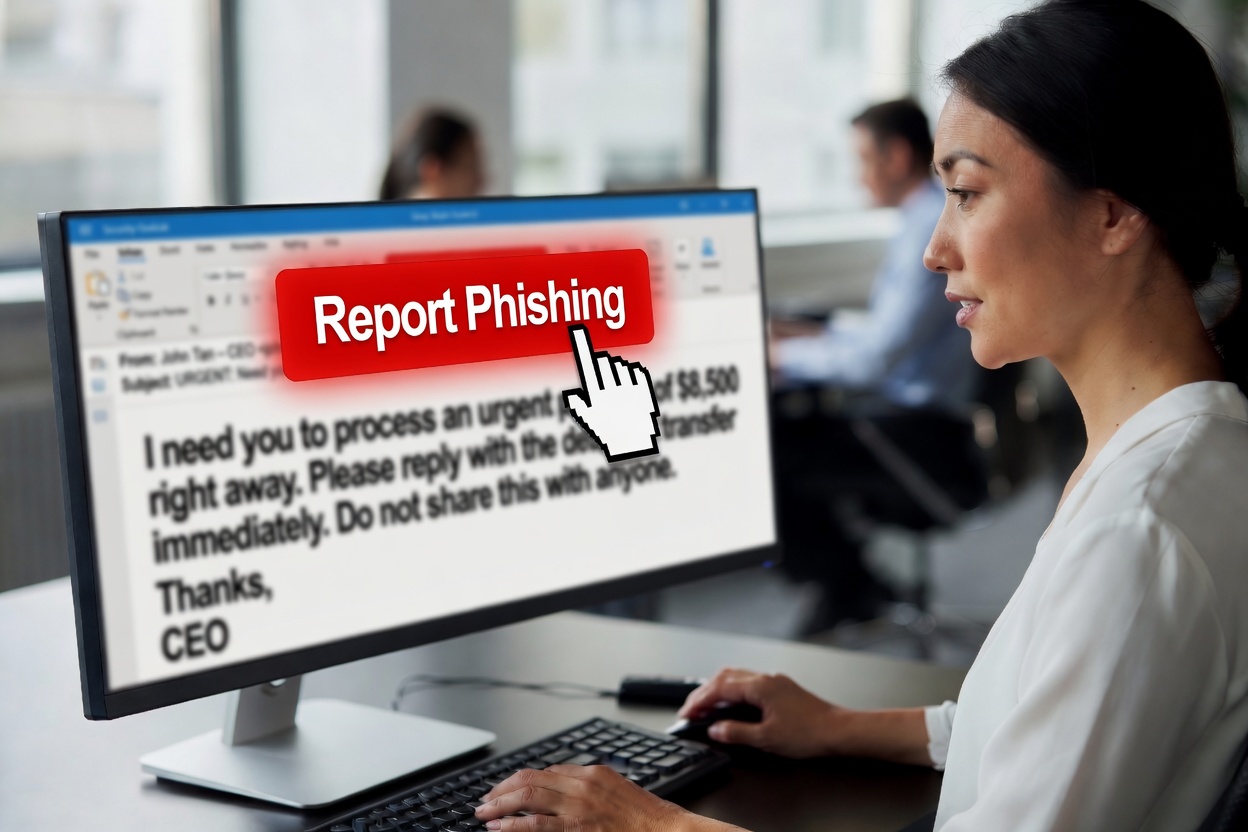
A human firewall is the first line of defense, but it is strongest when continuously reinforced by the wider security environment. This includes Human Risk Management and the broader security capabilities that protect and strengthen the organization behind the scenes. Through Adventus Cybersecurity Solutions and Services, these layers work together to create a more resilient and proactive security approach.
To learn how we can support your organization, get in touch with us today.